

Attribution Claims vs Attribution Implementation: Five Questions
Attribution access is nearly free, so listing it proves nothing. These five questions separate an agency that connected a dashboard from one that wired your CRM into LinkedIn.
Every LinkedIn Ads agency now lists attribution. It sits on the services page between creative and reporting, and it costs nothing to put there. The gap that matters is between an agency that has connected a dashboard and one that has wired your CRM stages back into LinkedIn, and from the outside those two look identical until you ask.
Five questions separate them. None require you to be technical, and all five have answers a real implementer gives immediately.
Why attribution is the easiest thing to claim
Access to attribution tooling is close to free. Dreamdata publishes a free plan and Factors.ai lists a free tier alongside its paid ones. Connecting one to an ad account is an afternoon. So that phrase describes a login, not a capability, and it cannot be the thing you are paying a retainer for.
Implementation is the part that is expensive, and it is invisible from the outside: server-side events that survive ad blockers, CRM stages pushed back into the platform, deduplication that does not inflate the numbers, and identifiers attached to every event so the platform can match it. That work either happened or it did not.
A dashboard tells you what happened. An implementation changes what the algorithm optimises against. Only one of those is worth a retainer.
The five questions
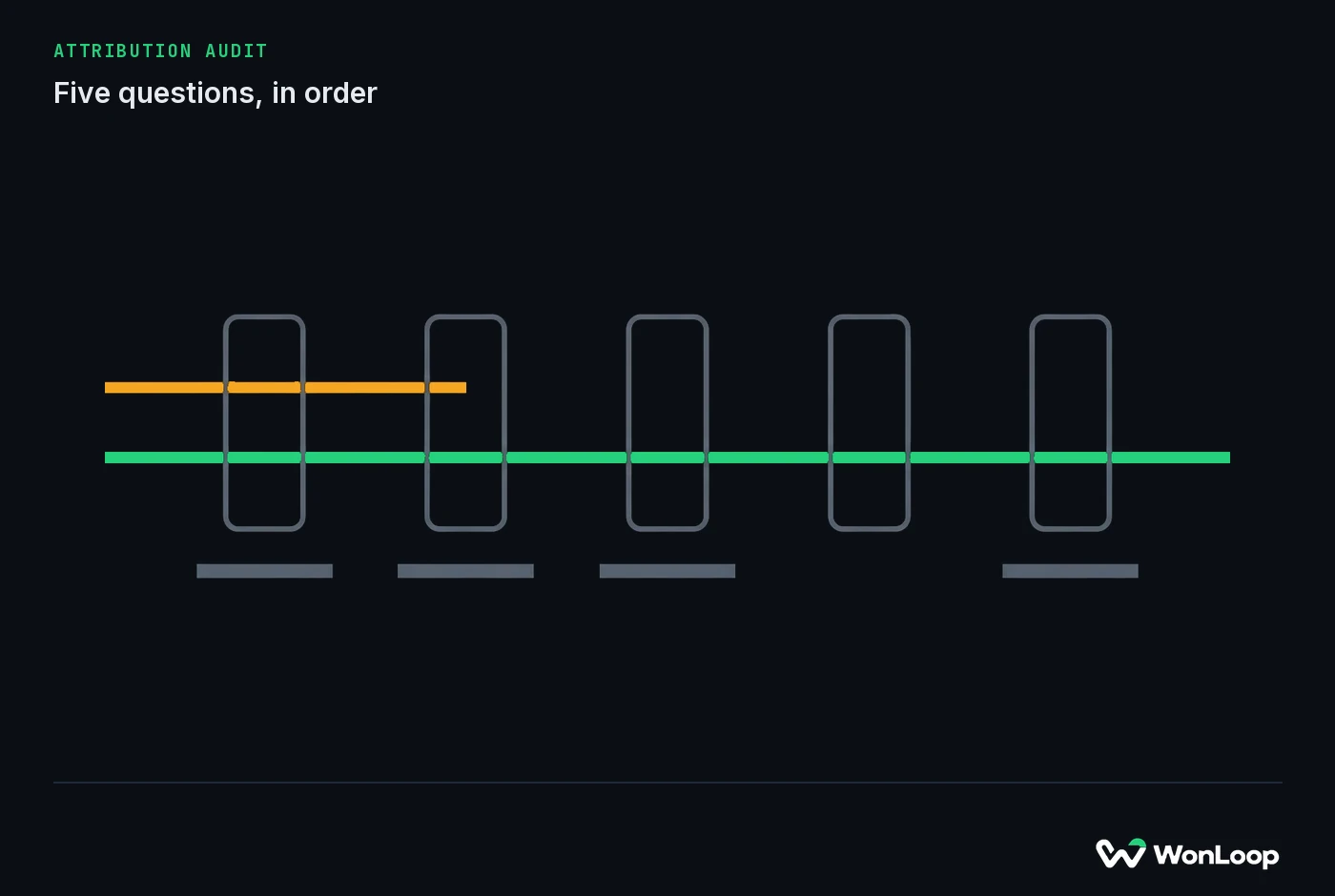
Ask these on a call. Do not send them in an email, because the value is in whether the answer arrives immediately or arrives next week.
ATTRIBUTION AUDIT
five questions, in order
5 steps
Which CRM stages do you push back into LinkedIn?
Real answer names the stages: MQL, SQL, opportunity, closed-won. A vague answer means offline import is off.
Are we sending server-side events, and what is the data source on each conversion rule?
Direct API on the server rules, or the pixel is doing all the work.
How are the pixel and server events deduplicated?
A shared event ID is the only correct answer here.
What identifiers ride on each event we send?
Hashed email at minimum. Unmatched events are dropped.
What is our conversion count this month versus before you started?
Recovered volume is the measurable claim.
The order matters. Question one establishes whether revenue data ever reaches the platform. Questions two through four establish whether the plumbing under it is sound. Question five asks for the number that would prove any of it.
What a wrong answer to question four actually costs
This is the one most people skip, and LinkedIn is unusually direct about it. Every event you stream needs at least one user identifier — a hashed email, the li_fat_id first-party cookie, or a name pair. Events without one are validated and then quietly discarded. LinkedIn’s own documentation states it plainly: “only matched events can be used for attribution and optimization”.
So an agency can be sending events correctly, see them accepted, and still be feeding the algorithm almost nothing. Match rate is the difference, it is diagnosable, and most accounts have never looked at it.
Why question three is not a technicality
Running the Insight Tag and the Conversions API together is the recommended setup, and it is also the easiest thing to install wrongly. LinkedIn resolves the overlap by event ID: “we discard the Conversions API event and count only the Insight Tag event” when both arrive with the same one.
Without a shared event ID nothing is discarded, both fire, and the account reports roughly twice the conversions it earned. Cost per conversion halves on the dashboard while the CRM stays exactly where it was — a flattering number produced by a broken install, which is the same disease as CPL theater arriving by a different route.
Attribution claimed against the thing implemented
| The claim | What implemented looks like |
|---|---|
| “We give you attribution” | A named tool, wired to the ad account, with someone accountable for the model |
| “We track conversions” | Server-side rules whose data source reads Direct API, not pixel-only |
| “We report on pipeline” | CRM stages pushed back into LinkedIn, so delivery optimises toward them |
| “Our dashboard shows ROI” | A conversion count before and after, and a match rate they can quote |
If the answers do not come
Silence on questions two, three and four is not proof of bad faith. Most agencies are genuinely good at strategy and creative and have never done the plumbing, because it sits between marketing and engineering and nobody owns it. The useful response is to get it wired, by them or by someone else.
The whole method is public if you want to run it yourself — the Conversions API implementation guide is the same document we deliver against, given away. If you would rather buy the execution, Signal Repair is $1,800 fixed over 14 days with a guarantee stated in recovered conversion volume, and it does not ask for your media budget. And before either, the signal checker tells you which of the five answers you already have.
The bottom line
Attribution access is cheap and attribution implementation is not, so the services page tells you nothing. Ask which CRM stages get pushed back, whether the conversion rules read Direct API, how the pixel and server events are deduplicated, what identifiers ride on each event, and what the conversion count did.
A real implementer answers all five on the call. If the answers are vague, what you bought is a login rather than a build — and you can verify that yourself in Campaign Manager this afternoon.