

LinkedIn Learning Phase: The Arithmetic of Starved Campaigns
LinkedIn campaigns need roughly 50 conversion events a month to stop guessing. Split $10,000 six ways and every campaign gets 17, so none of them ever graduate.
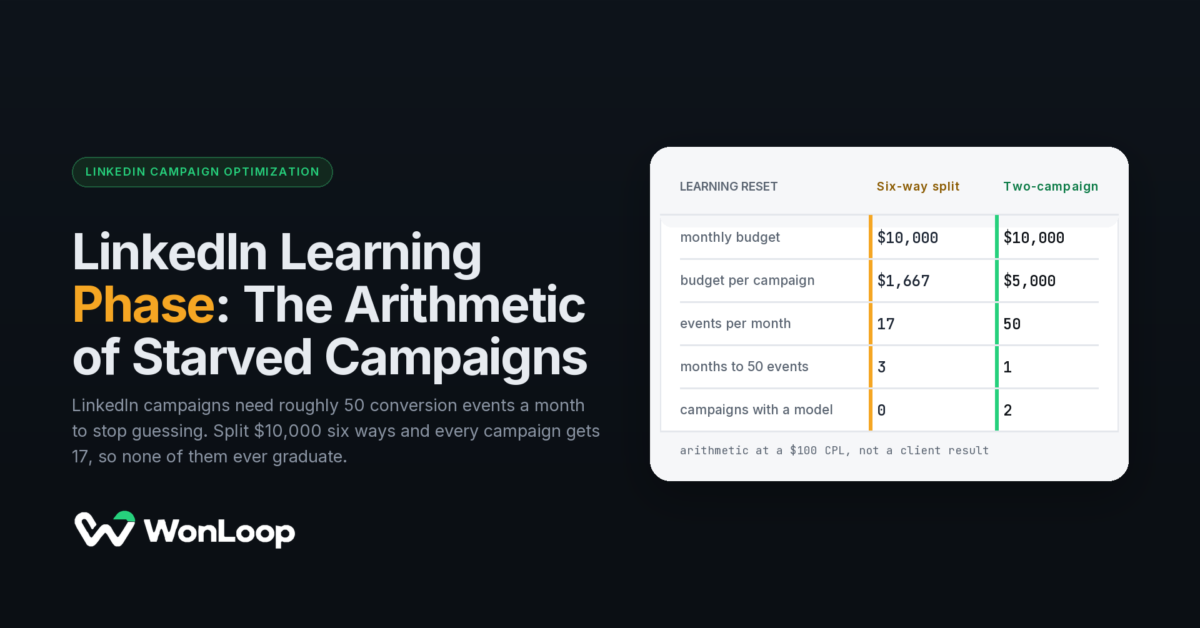
Six campaigns, $10,000 a month, and every one of them stuck. That account is not underperforming because the creative is weak or the targeting is loose. It is underperforming because no campaign in it ever collected enough conversion events to leave the LinkedIn learning phase, so the algorithm spent the whole month guessing. The fix is arithmetic, not creative, and the arithmetic is unforgiving.
What the LinkedIn learning phase actually is
When a campaign starts, or when you change the event it chases, LinkedIn has no model of who converts for you. It spends impressions finding out. During that period delivery is erratic, cost per conversion is high and unstable, and the numbers in Campaign Manager describe a search, not a result.
The exit condition is volume. LinkedIn’s algorithm needs roughly 50 conversion events per campaign per month before delivery stabilises. Not 50 across the account. Fifty per campaign, per month, on the event that campaign chases.
Budget, bid and target event are all campaign-level settings — LinkedIn’s own campaign documentation describes delivery as driven by pacing, forecasting and machine learning set per campaign. That is why the threshold is per campaign too, and why the split is the thing that kills you.
That single number is the whole post. Everything below is what happens when you divide a budget without checking it.
The arithmetic of a starved campaign
Take a $100 cost per lead — reasonable for B2B on LinkedIn, and generous in some verticals. Fifty events at $100 is $5,000 per campaign per month. That is the price of one campaign graduating, at that CPL. Change the CPL and the floor moves with it: at $150 a lead it is $7,500, at $60 it is $3,000.
Now split $10,000 six ways and watch what the split does:
| Campaigns | Budget each | Events each | Exits learning? |
|---|---|---|---|
| 6 | $1,667 | 17 | None |
| 4 | $2,500 | 25 | None |
| 3 | $3,333 | 33 | None |
| 2 | $5,000 | 50 | Both, just |
Six campaigns on $10,000 is not six chances to win. It is six campaigns that all fail the same test, and a month of spend that taught the platform almost nothing. Two campaigns on the same money is two campaigns that graduate. The budget did not change. The number of survivors did.
Splitting a budget does not spread risk on LinkedIn. It spreads starvation.
Why more campaigns feels safer and is not
The instinct is reasonable everywhere else. More variants, more segments, more chances for one to work. On a platform that learns per campaign, the instinct inverts: each new campaign is another learning phase to fund, paid for out of the same budget.
Three habits cause most of it. Splitting by seniority when the creative is identical. Running one campaign per persona because the deck had four personas. Duplicating a campaign to test a headline, which restarts learning on both. None of these are wrong in principle. They are wrong at $10,000 a month, because the budget cannot pay for that many learning phases at once.
Changing the target event restarts the LinkedIn learning phase
Learning is not a one-time tax. Change what a campaign chases and the model you paid for is discarded. Moving a campaign from form fill to a sales-accepted lead — the right move, and the one pushing CRM stages back into LinkedIn exists to enable — resets it to zero.
Which is why the sequence matters. Change one campaign, write down the date, and judge it after about 50 events on the new target rather than after a week of noise:
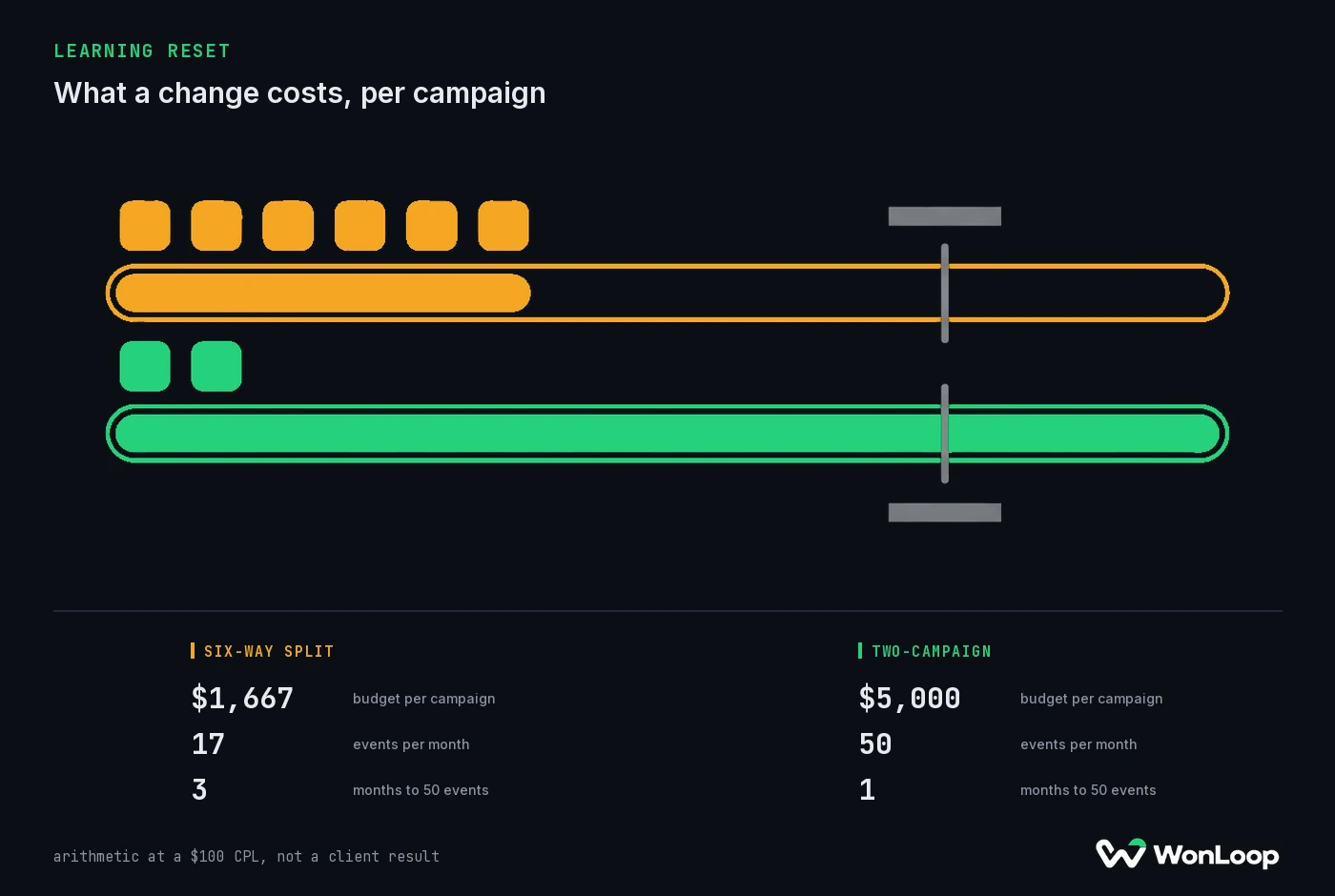
LEARNING RESET
what a change costs, per campaign
| Metric | Six-way split | Two-campaign |
|---|---|---|
| monthly budget | $10,000 | $10,000 |
| budget per campaign | $1,667 | $5,000 |
| events per month | 17 | 50 |
| months to 50 events | 3 | 1 |
| campaigns with a model | 0 | 2 |
arithmetic at a $100 CPL, not a client result
Three months to graduate one campaign is three months of paying learning-phase prices. Most accounts do not wait that long. They change something at week three, the clock resets, and the account never leaves the first month.
The honest floor this produces
Two campaigns at $5,000 each is $10,000, and that assumes a $100 CPL and no testing budget. Add a third campaign for prospecting, or a CPL of $130 rather than $100, and the number that actually clears learning sits around $8,000 a month as a working minimum for a structure that can support more than one campaign.
That is where our spend floor comes from. It is not a filter for bigger clients. It is the point below which the mechanism we sell cannot function, which is why we say so publicly rather than taking the money and reporting a cost per lead that falls while lead quality falls with it.
Run this check on your own account
It takes ten minutes and needs nothing but Campaign Manager.
Open your campaign list and add the conversions column for last month. For each campaign, read the conversion count on its target event. Count how many cleared 50. If the answer is none, you do not have a creative problem yet — you have a structure problem, and creative tests run inside it will return noise.
Then check the second thing, because the first number is often wrong. A campaign can be adequately funded and still show 17 events because the events are not being recorded. Browser-side tracking loses conversions to ad blockers, cookie expiry and iOS privacy, so a starved-looking campaign is sometimes a properly funded one with a reporting leak. The Conversions API implementation guide covers the wiring that closes it, and the signal checker answers which of the two you are looking at without a call.
What to do with the answer
If campaigns are starved, consolidate before you optimise anything. Merge the segments whose creative is identical. Kill the campaign you kept running because someone asked for it. Fund what remains to at least 50 events on the event you actually care about, then leave it alone long enough to graduate.
If the events are missing rather than absent, fix the measurement first. Optimising against a partial signal is how an account ends up with a healthy dashboard and a CRM full of nothing — the failure the Signal Repair engagement is built to correct in 14 days, with a guarantee stated in recovered conversion volume rather than satisfaction.
The bottom line
The LinkedIn learning phase is a volume threshold, not a waiting period. Roughly 50 conversion events per campaign per month, or the algorithm never stops guessing. Six campaigns on $10,000 gives every one of them 17 events and none of them a model. Two campaigns on the same $10,000 gives you two that work.
Count the conversions per campaign on last month’s report before you touch the creative. If nothing cleared 50, consolidate. If the count looks impossibly low for the spend, the problem is the tracking rather than the budget, and that is the thing to fix first.