

How to Audit a LinkedIn Ads Agency Before You Sign
You cannot evaluate a LinkedIn Ads agency by interviewing it. Run five checks on your own account first, then hand the findings over and watch what the agency does with them.
Checking your own setup? Run the free LinkedIn Insight Tag Checker to inspect browser requests before reviewing account-side attribution.
Choosing a LinkedIn Ads agency is a decision you make on a call and find out about in month four. Every pitch deck contains the same nouns — attribution, full-funnel, CRM integration — and none of them are falsifiable in an hour. So stop trying to evaluate the agency. Audit the account instead. Five checks you can run yourself, in Campaign Manager and your CRM, produce evidence that makes the sales conversation answerable.
You cannot tell a good agency from a bad one by listening to them. You can tell by handing them findings and watching what they do with them.
Why the usual LinkedIn Ads agency due diligence tells you nothing
The standard checks are case studies, client logos, a Clutch rating and a reference call. Each has a structural problem. Case studies are written by the agency, name the metric that moved, and omit the ones that did not. Logos prove somebody signed, not that anybody renewed. References are chosen by the vendor. None of it tells you whether the people who would touch your account can wire a server-side event to a CRM stage.
Certifications are weaker than they look. LinkedIn Marketing Partner status is real, and it is also a commercial relationship with revenue thresholds attached. It says an agency spends at scale. It does not say who does the implementation, or whether that person is on your account.
The alternative is cheap. Everything below runs on access you already have, in about 40 minutes, and every finding is a fact rather than a claim.
Run the five checks before you take the call
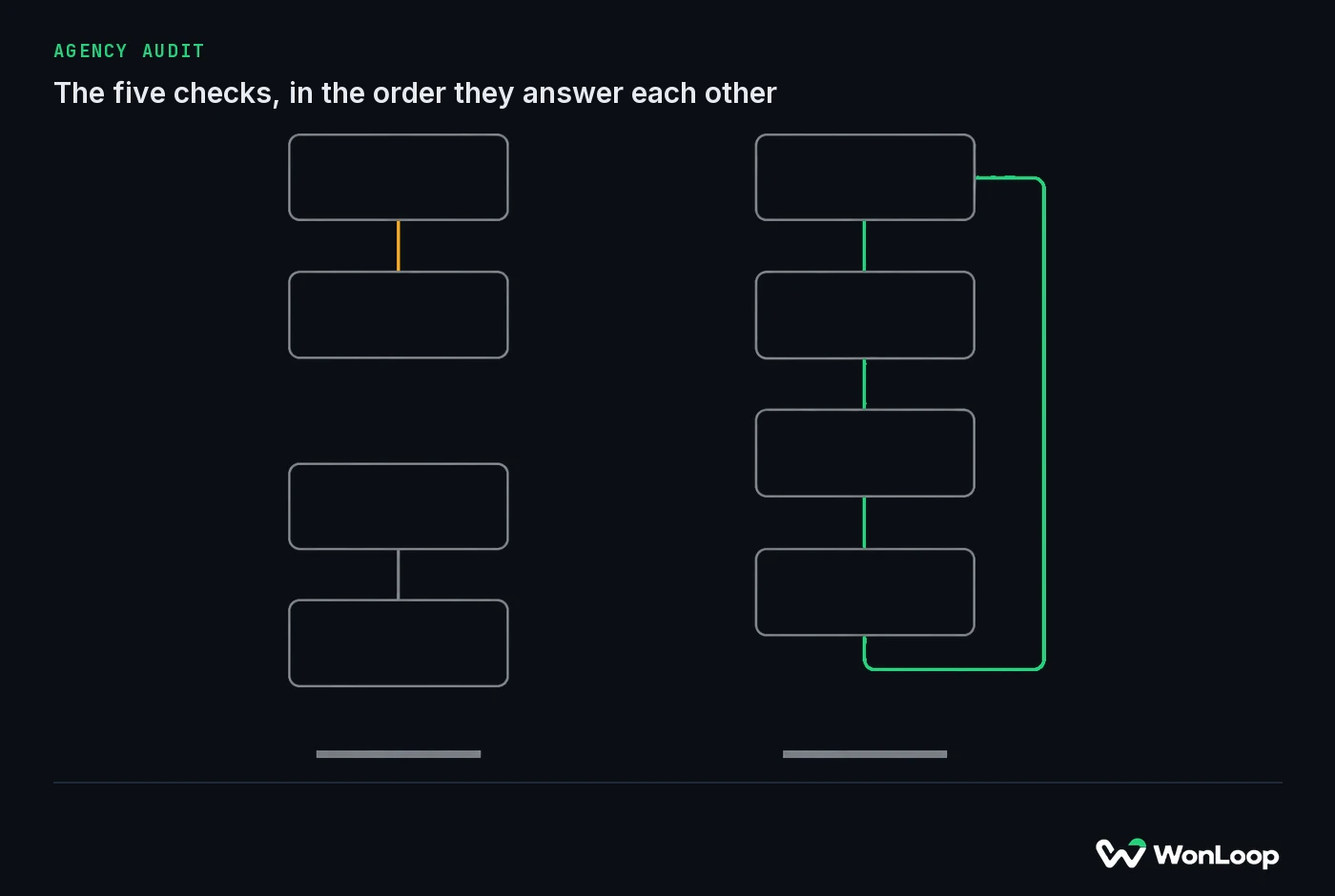
Do them in order. Each one narrows what the next one can mean, which is why a checklist beats a list of questions: by step four you are not asking whether the account has a problem, you are asking which one.
AGENCY AUDIT
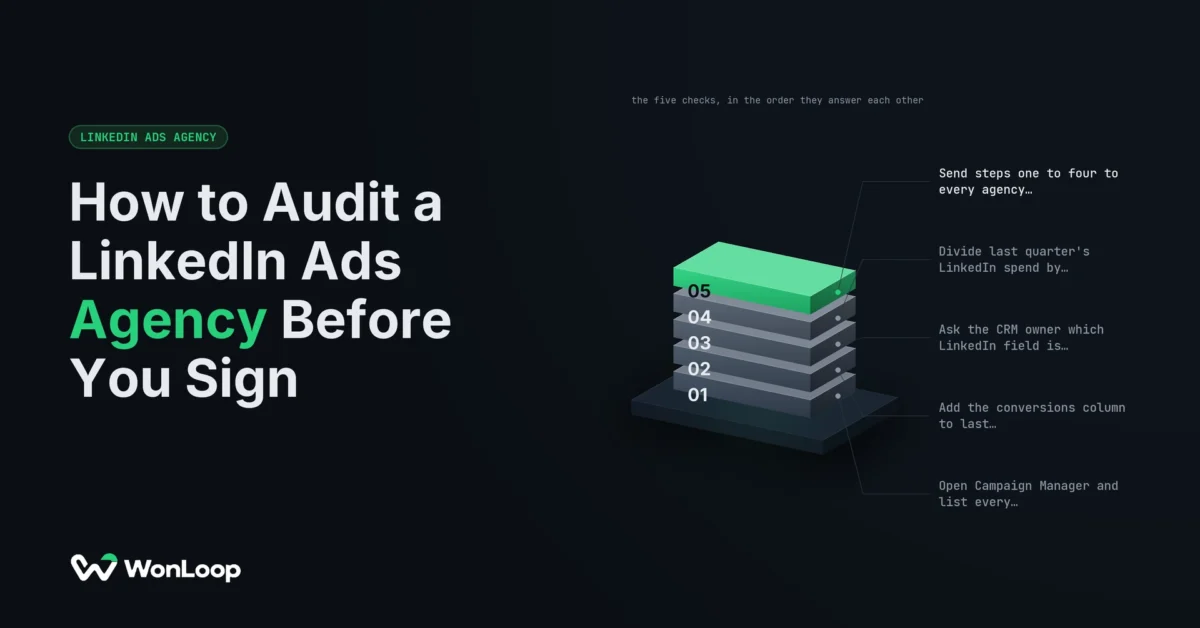
the five checks, in the order they answer each other
5 steps
Open Campaign Manager and list every conversion rule under Measure, then Conversion tracking.
Write down the data source on each one. Expect a mix you can name in a sentence. If every rule says Insight Tag and none says Conversions API, the account is browser-only and every number downstream inherits that.
Add the conversions column to last month's campaign report and read the count per campaign, not per account.
Expect at least one campaign clearing 50 events on its target event. If none does, no agency can fix delivery with creative or targeting.
Ask the CRM owner which LinkedIn field is stamped on a new lead and pull the closed-won deals from the last 2 quarters.
Expect a campaign name or a click identifier on most of them. Blank fields mean the loop was never closed at the CRM end either.
Divide last quarter's LinkedIn spend by closed-won deals sourced from it.
Expect a number you can say out loud to a CFO. If the only figure anyone can produce is cost per lead, that is the metric the account is actually optimizing toward.
Send steps one to four to every agency pitching you and ask what they would change in the first 30 days.
Expect a specific implementation sequence with named systems. A reply about creative testing and audience refinement answered a different question.
Step one is the one people skip, and it decides the value of every number after it. A conversion rule sourced from the Insight Tag fires in the browser, so ad blockers, cookie expiry and iOS privacy remove a share of events before the platform ever sees them. A rule sourced from the Conversions API is sent server-side and survives all three. Reading the data-source column is a thirty-second check that tells you whether the report you are about to argue over is a measurement of the market or a measurement of browsers. The full implementation sequence is a separate job; here you only need to know which one you have.
What each finding actually means
A finding is not a verdict. The same symptom has two very different causes, and the pairing below is what stops you buying the wrong engagement.
| What you found | What it means | What to ask the agency |
|---|---|---|
| Every rule says Insight Tag | Browser-only signal; blocked events never reach the platform | Who writes the server-side events, and against which CRM object? |
| No campaign cleared 50 events | Structure problem, not a creative problem | Which campaigns would you merge before touching the ads? |
| CRM has no LinkedIn field on won deals | The loop was never closed at the CRM end | Which CRM stages get pushed back, and who owns that field? |
| Nobody can state cost per closed-won | Reporting stops at the lead | What will the monthly report show on line one? |
| All four are clean | Measurement is not your problem | Then the engagement is campaign work, and it should be priced as that |
The last row matters as much as the first four. If the account is clean, measurement work is not what you need, and an agency that sells you a tracking rebuild anyway is doing to you what this post is trying to prevent.
Turn the findings into questions a LinkedIn Ads agency cannot deflect
Hand over what you found and ask for a 30-day plan against it. You are not testing knowledge; you are testing whether the answer names systems, objects and owners. “We would tighten up your tracking” is a sentence anyone can produce. “We would send the sales-accepted stage from HubSpot as a server-side event, deduplicated against the existing pixel rule, then move the campaign target off form fill once it has thirty days of history” is a sentence only somebody who has done it can produce.
Three follow-ups separate the two. Ask who writes the integration — the person on the call, a partner, or your own developer. Ask what happens to the campaign’s learning when the target event changes, because changing the target event discards the model and an agency that does not volunteer that is going to surprise you in week three. Ask what the first monthly report shows on line one. If the answer is cost per lead, you have just been told what the engagement will optimize toward, whatever the deck said.
These are diagnostic questions, not the five questions that separate attribution access from attribution implementation — that set is about capability in general, this one is about your account in particular.
Price the LinkedIn Ads agency engagement against what the audit found
The findings should change the shape of the deal, not just the vendor. An account that fails step one has a fixed-scope implementation problem, and implementation problems are badly served by a monthly retainer that starts before the plumbing works. An account that passes all four has a campaign problem, and campaign problems are badly served by an audit you have already run yourself.
Spend is the other half of the arithmetic. LinkedIn needs roughly 50 conversion events per campaign per month for delivery to stabilise, which is about $5,000 per campaign at a $100 cost per lead, and budget is set per campaign rather than per account. Below roughly $8,000 a month of cold acquisition spend the mechanism cannot run, and an agency quoting a management fee on top of that is selling you a service that cannot mathematically succeed. Ask any agency what their floor is and what it is derived from. A floor with arithmetic behind it is a disclosure. A floor without one is a sales qualification.
What a good 30-day answer contains
Plans are easy to write and hard to fake at the level of the object being changed. A serious first month is sequenced, because each step invalidates the measurement of the one before it, and a plan that runs them in parallel is a plan nobody has executed. Five things should appear in order:
- A server-side event, named. Not “we’ll fix tracking” but which event, sent from which system, against which CRM object, deduplicated against the existing pixel rule so the same conversion is not counted twice.
- A baseline captured before anything changes. Thirty days of conversion volume on the current setup, written down. Without it there is no before-and-after, and every improvement claimed afterwards is unfalsifiable.
- A structure decision, with campaigns named. Which campaigns merge, which stop, and what each survivor’s monthly budget becomes. If the audit found no campaign clearing 50 events, this step comes before any creative work and a good plan says so.
- A stated waiting period. Changing a campaign’s target event restarts learning, so the honest plan books roughly 30 days of not judging the result. An agency promising a lift in week two has either not changed the target event or is going to report on noise.
- The first report’s line one. Agreed in advance, in writing, before any money moves. Whatever sits on line one is what the engagement will optimise toward for the next year.
Notice what is absent: audience refinement, creative testing, a content calendar. Those are real work and they are month two. Any of them appearing in week one on an account that failed step one means the plan was written before anybody looked at the account.
The bottom line
You cannot audit a LinkedIn Ads agency by interviewing it. You can audit your own account in 40 minutes and let the findings interrogate the agency for you. Read the data source on every conversion rule, count conversions per campaign rather than per account, check whether a LinkedIn field survives onto closed-won deals, and divide spend by closed-won. Four facts, gathered before the call, change what the call is about.
If steps one to three fall apart, the problem is the data path and not the campaigns. That is the whole scope of LinkedIn Signal Repair: fixed price, 14 days, and a written before-and-after showing the conversion volume the account was losing, under a guarantee stated as a number. If you would rather run the check with someone on the call, the free tracking check walks the same four steps and costs nothing.