

LinkedIn Conversion Values: What an Opportunity Is Worth
An opportunity is worth its win rate times what it books if won: 25% of $20,000 is $5,000. Keep that estimate apart from the won amount, and never add stages together.
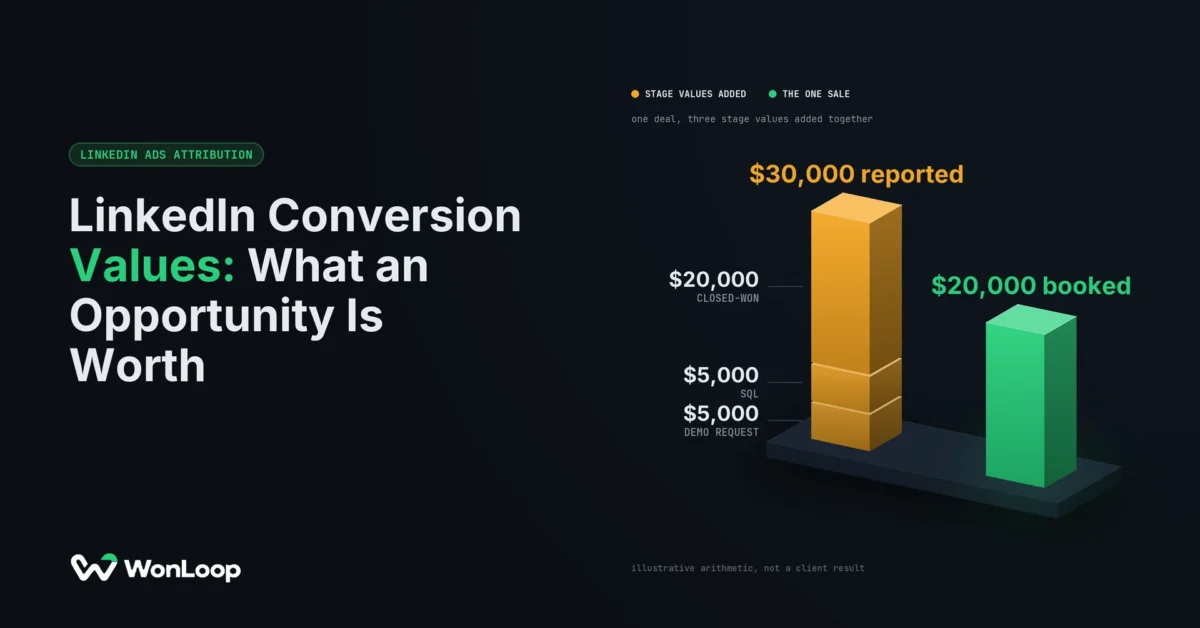
One deal. The demo request fires a conversion worth $5,000. The SQL fires another at $5,000. The closed-won fires a third at $20,000. Pull a report that sums every conversion rule and that one $20,000 sale shows $30,000 of value. Nobody lied. Three LinkedIn conversion values just landed on the same deal, and the report added them up.
That is the trap this post takes apart. The numbers here are illustrative arithmetic, not a client result. The fix is to decide what each value means before you type an amount, then keep the stages apart.
A dollar sign does not turn a forecast into revenue.
How one deal reports $30,000 of LinkedIn conversion values
Each conversion rule in Campaign Manager carries its own value. Each rule counts its own events. A report that totals value across rules has no idea that three events came from one buyer and one contract. It sees three rows and adds them.
So the $30,000 is real arithmetic on fake inputs. $5,000 was a guess about a demo. $5,000 was a guess about an SQL. $20,000 was the sale. Only one of those three is money. The other two are forecasts of that same money, and they got counted on top of it.
This is CPL theater with a bigger number. A cost-per-lead report flatters the lead. A summed value report flatters the pipeline. Both look healthy in the dashboard and fall apart the moment finance asks which deals they refer to.
What a conversion value is supposed to mean
Write the meaning next to the rule before you pick the amount. Three questions settle it. What event does this rule record: a form, an opportunity, or a sale? What does its value stand for: a fixed planning number, a weighted forecast, booked revenue, or cash? And who in the company agrees with that answer?
Those labels are not interchangeable. A signed annual contract and a monthly payment are different measures. The Amount field on an opportunity is not what finance books. A value you typed for a lead is not an invoice. Pick one meaning per rule and write it down.
| Value approach | What the number means | Main risk |
|---|---|---|
| Fixed stage value | Every event on the rule gets the same written-down estimate | Deal size and win odds vanish into one flat number |
| Expected value per opportunity | Win rate times the amount you would book if it wins | Stale amounts and gut-feel stage odds skew it |
| Closed-won amount | What the won deal actually booked, on one stated basis | First-year, total contract and cash collected get mixed |
| Count only, no value | How many events met a written stage rule | People still read the count as revenue |
The last row is a reporting choice. Some connectors want a value on every event. If yours forces a default, write that down too, and keep the total that default produces out of any revenue claim.
The cohort arithmetic behind a $5,000 opportunity
For one opportunity, the planning formula is short. Expected value equals the chance it wins times what it books if it wins.
For a fixed value on a stage, work from a past cohort. Take the opportunities that entered that stage in one period. Add up what the winners booked. Divide by every opportunity in the cohort, winners and losers both. That gives revenue per opportunity for that group. It informs the next estimate. It does not promise it.
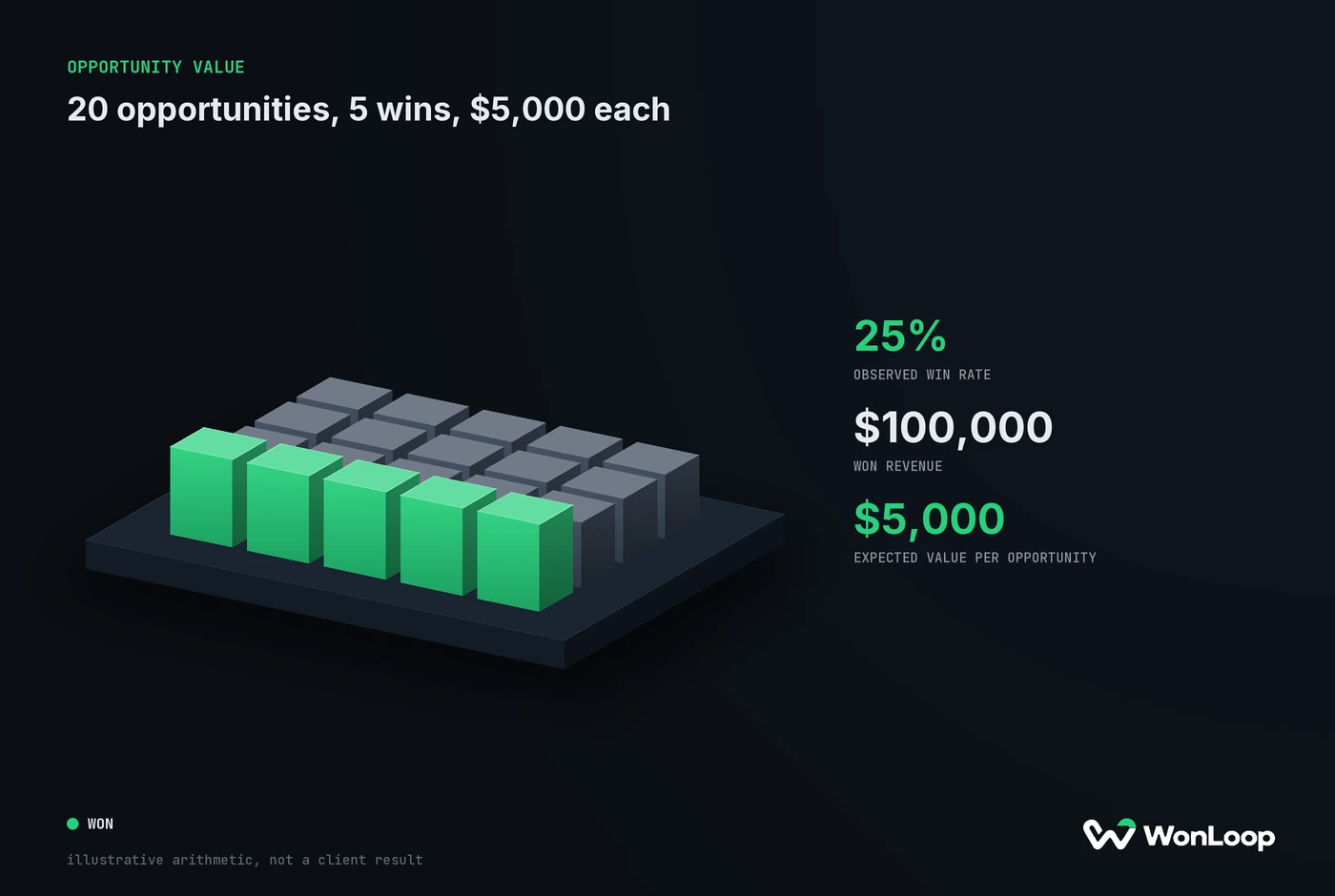
OPPORTUNITY VALUE - cohort arithmetic, one planning estimate

1. Pick the cohort. Take 20 qualified opportunities that entered the same stage.
2. Count the wins. Five closed-won deals give a 25% win rate.
3. Fix the revenue basis. Each win books $20,000 of first-year revenue.
4. Divide. $100,000 of won revenue over 20 opportunities is $5,000 each.
5. Label it. $5,000 is an expected value per opportunity, not a sale.
- illustrative arithmetic, not a client result
Same answer the short way: 25% times $20,000 is $5,000. That $5,000 is a cohort average. No single open opportunity will book $5,000. Three in four, or 75%, will book nothing. One in four will book $20,000.
The denominator is where most of these go wrong. Count every opportunity that entered the stage, not only the closed ones. Losses often close fast and wins close slow, so a closed-only win rate skews on the day you run it. Pick a cohort old enough that few records are still open, and say how many are.
Check the mix, too. New-logo deals, renewals and small expansions have different sizes and different buying cycles. One blended number misprices all three. With a thin history, show the counts and give a range. A range you can defend beats a precise figure you cannot.
WonLoop has no client results to put in this worksheet. The figures above are illustrative. In a real account, your own CRM and finance records supply the inputs.
Fixed values vs amounts sent per event
Find out where the value gets set and what actually reaches LinkedIn. There are two patterns, and they behave differently.
The first is an amount on each event. LinkedIn’s Conversions API documentation shows event payloads with a conversionValue object that holds currencyCode and amount. So the API can carry a value per event. It does not tell you which business number belongs in it. That part is yours.
The second is a fixed value on the rule. The native lifecycle-stage setup in HubSpot’s LinkedIn conversion guide asks you to enter a monetary value for the event. Treat that as one flat number per event until you see an event carry its own deal amount. The HubSpot side of that wiring is in mapping HubSpot lifecycle stages to LinkedIn conversions. The Salesforce version, where the opportunity record drives the event, is in sending Salesforce opportunity stages to LinkedIn.
Then run six checks on your own route:
- Is the value fixed on the rule, or sent with each event?
- Which CRM field supplies the amount?
- Which field supplies the currency?
- What goes out when the amount is blank?
- Does a rule default overwrite a value sent on the event?
- What happens when someone edits a deal amount after it was sent?
Answer each one with a test event and the current docs. Precedence between a rule default and an event value can differ by route, so check yours rather than guess. If the business needs per-deal amounts and the connector only takes a flat value, that is a scope gap. Use the flat value and label it, or pick a route that sends amounts.
Stop adding funnel stages together
An opportunity can fire a qualified-stage event and later a won event. Both are useful signals. They are not two pools of money.
Run the cohort numbers through one deal. It gets $5,000 of expected value when it qualifies. Later it wins a $20,000 first-year contract. Add the two and you get $25,000. The business sold $20,000. It logged one forecast and then one outcome for the same contract.
Keep each stage in its own column. Put the rule, the stage and the value basis next to every total. Never roll lead values, opportunity values and won amounts into one revenue headline.
The same thing happens with buying committees. Four contacts on one deal can each fire a won event if the sync keys on the contact. That is one contract reported 4x. Key the won event on the deal, and decide which person carries it before you send anything.
Corrections need a plan as well. Editing a deal amount should update the record, not create a second sale. Check what update or correction path your route supports. Sending a negative purchase or a fresh event ID to cancel an old one just adds more rows to argue about.
This is the gap between attribution you implement and attribution you claim. A dashboard can add up correctly while every number in it describes the same deal.
Currency, revenue horizon and model version
A value with no currency and no revenue basis is half a number. Pick one basis: first-year contract value over 12 months, total contract value, or something else you can name. Say how discounts, taxes, cancellations and refunds are handled. Ask finance to sign off rather than grabbing the biggest field in the CRM.
Currency is the quiet one. A GBP amount sent with a USD code is now a wrong number with a confident label. If you convert, write down where it happens and which rate you use. A report will not fix a payload that lied about its currency.
Version the model. Save the cohort, the formula, the inputs and the date it took effect. When you change it, say whether new values apply going forward and how to read a chart that spans the change. A higher expected value can come from a new assumption, not from better campaigns. The dashboard will show more money while the deals stay the same.
Leave timestamps alone. Rewriting them or replaying old events to force a new model into an old report makes the history untrustworthy. LinkedIn also rejects offline events older than 90 days, so a backfill has a hard edge anyway. Post-click windows run from 1 day to 90 days for most event types. Only a few types, such as purchase and qualified lead, get 365 days. Match the window to the sales cycle.
Check LinkedIn conversion values before you claim a bidding change
Send one controlled test event. Know its stage, amount, currency, event ID and timestamp before it leaves. Then look at the source record, the delivery log and whatever your route shows on the LinkedIn side.
Keep three things apart: accepted, matched and credited. LinkedIn’s API docs say only matched events can be used for attribution and optimization. A request that came back accepted with a value in it proves the payload was well formed. It does not prove a match, and it does not prove a campaign got credit.
A higher value also does not mean the campaign now bids toward revenue. Check the campaign objective, the bidding options it offers and which conversions it uses before you say so. Volume matters here too. Opportunity events are rarer than form fills, and a campaign still needs enough of them each month to learn, which is the math behind the minimum LinkedIn Ads spend.
When you read a value report, name which of four numbers it shows:
- A total of configured LinkedIn conversion values.
- Expected revenue under your written model.
- Won revenue credited by an attribution model.
- Revenue the ads caused, which is a separate test.
Only the third is won revenue, and even that is credit, not proof of lift. Calling the first two ROAS is how a $20,000 sale becomes $30,000 in a board deck.
The bottom line
LinkedIn conversion values should stand for one defined business number per rule. Use a fixed value when its cohort math is written down. Use a per-opportunity estimate when the amounts and win odds are current. Use the won amount when the event is a sale. Never add stage values together and call the sum revenue.
Keep currency, revenue basis and model version on every total. If the data cannot support a dollar figure, report the stage counts and skip the dollar sign. LinkedIn Signal Repair is the fixed-scope engagement that wires those definitions from the CRM into Campaign Manager and checks that they arrive intact. It fixes what the value means. It does not make an event worth more.